How Small and Mid-Sized Businesses Can Use AI Without Big Budgets
Many small businesses avoid AI due to cost and complexity fears, often based on misconceptions.
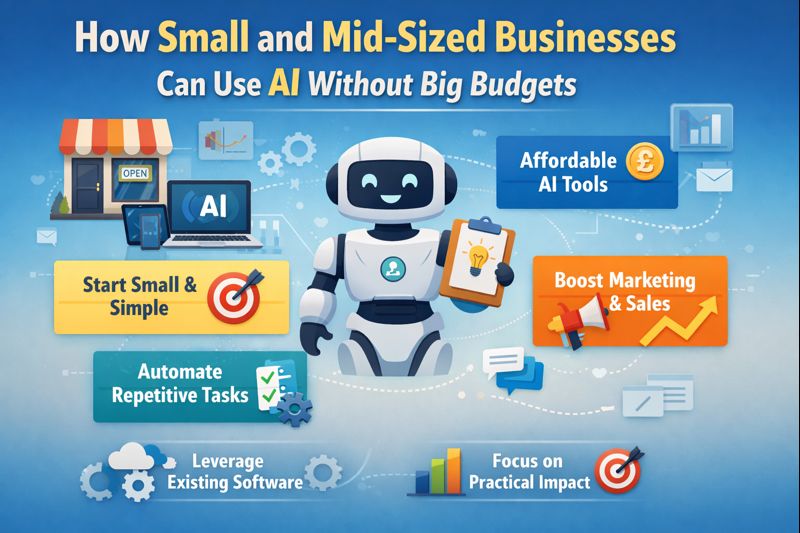
Artificial intelligence is no longer a futuristic concept reserved for large corporations with dedicated data teams and million-pound budgets. Today, AI is quietly reshaping how small and mid-sized businesses (SMBs) operate — often without those businesses even realising it.
From automating repetitive admin work to improving customer service, marketing, forecasting, and decision-making, AI has become more accessible, affordable, and practical than ever before. Yet many SMBs still believe AI is too complex, too expensive, or too risky to adopt.
This belief is understandable — but increasingly outdated.
The truth is that AI does not require massive investment, in-house engineers, or radical transformation. When approached strategically, AI can be introduced gradually, affordably, and in ways that deliver real value almost immediately.
This article explains how small and mid-sized businesses can use AI without big budgets, focusing on practical use cases, realistic expectations, and cost-effective approaches.
Understanding AI in a Business Context
Before discussing implementation, it is important to clarify what “AI” actually means in everyday business terms.
AI in most SMBs does not mean building complex machine-learning models from scratch. Instead, it usually involves:
- Automation powered by intelligent rules
- Pattern recognition and prediction
- Natural language processing (text and speech understanding)
- Decision support systems
- Intelligent assistants and tools
In practice, AI is often embedded into software that businesses already use — accounting systems, CRMs, marketing platforms, scheduling tools, and customer support systems.
Rather than replacing people, AI typically augments human work, removing friction, reducing errors, and freeing time for higher-value tasks.
Why AI Adoption Feels Intimidating for SMBs
Despite AI becoming more accessible, many small and mid-sized businesses still hesitate to adopt it. This hesitation is understandable, as it is often driven by a set of common concerns that feel very real at a smaller scale.
Cost fears are usually at the top of the list. Many business owners assume AI requires large upfront investment, expensive software, or long-term commitments that strain already tight budgets. In reality, much of today’s AI is available through affordable subscriptions or built into existing tools, allowing businesses to start small without significant financial risk.
Technical complexity is another major worry. The idea of needing data scientists, engineers, or specialist teams can be intimidating. However, modern AI tools are increasingly designed for non-technical users, with intuitive interfaces and minimal setup required. Most small businesses can use AI effectively without writing code or hiring specialists.
There is also often uncertainty around return on investment. Without clear examples, it can be difficult to see how AI will translate into measurable value. This uncertainty is amplified when AI is viewed as a broad, abstract concept rather than a tool for solving specific problems.
Data concerns further discourage adoption. Many businesses believe AI only works with large, perfectly structured datasets. In practice, many AI applications deliver value using limited but relevant data.
Finally, resistance to change plays a role. Introducing new technology can feel disruptive to established workflows and team routines.
These concerns are valid — but they often stem from misconceptions about what AI adoption actually looks like at a small or mid-sized scale. When approached gradually and purposefully, AI can be far more practical and manageable than it first appears.
The Reality: AI for SMBs Is Incremental, Not Transformational
One of the biggest mistakes businesses make is thinking that AI adoption must be all-or-nothing.
In reality, successful AI adoption is incremental. It starts small, focuses on specific problems, and builds over time.
You do not need:
- A full AI strategy on day one
- Custom algorithms
- Large data science teams
- Organisation-wide transformation
Instead, you need:
- One clear problem
- One measurable outcome
- One simple AI-enabled solution
Identifying the Right Starting Point
AI should never be adopted “because it sounds innovative”. It should solve a real business problem.
Good starting points are usually:
- Tasks that are repetitive
- Processes prone to human error
- Activities that consume disproportionate time
- Decisions made with incomplete information
- Areas where response time matters
Common High-Impact Areas
- Customer support and enquiries
- Marketing content and campaigns
- Scheduling and planning
- Sales follow-ups and lead qualification
- Data analysis and reporting
- Internal documentation and knowledge sharing
Using AI for Administrative Automation
Administrative work is one of the most overlooked opportunities for AI adoption.
Many SMBs lose hours every week to tasks such as:
- Data entry
- Document processing
- Invoice handling
- Email sorting
- Appointment scheduling
AI-driven automation can significantly reduce this workload without expensive systems.
Practical Examples
- Automatically extracting information from invoices or forms
- Categorising emails and flagging priority messages
- Scheduling meetings based on availability
- Generating summaries of long documents
- Validating data before it enters core systems
These automations do not replace staff — they allow them to focus on tasks that require judgment, creativity, or personal interaction.
Improving Customer Support Without Expanding Teams
Customer expectations have changed. Fast responses are now the norm, even for small businesses.
AI can help SMBs deliver better support without hiring additional staff.
AI-Enabled Support Capabilities
- Answering frequently asked questions instantly
- Routing enquiries to the right person
- Providing draft responses for staff to review
- Offering 24/7 basic support coverage
- Analysing customer sentiment and recurring issues
Importantly, AI does not have to fully replace human support. Many businesses use it as a first line of assistance, with humans stepping in for more complex cases.
Using AI in Marketing Without Large Budgets
Marketing is another area where AI can deliver strong returns quickly.
Small businesses often struggle with:
- Consistent content creation
- Targeting the right audience
- Analysing campaign performance
- Personalising messages
AI tools can support marketing teams — or even solo founders — by accelerating output and improving relevance.
Practical Marketing Uses
- Drafting blog posts, emails, and social content
- Generating headline and copy variations
- Analysing which campaigns perform best
- Segmenting customers based on behaviour
- Personalising messages at scale
Rather than replacing creativity, AI often acts as a creative accelerator, helping businesses do more with limited resources.
AI for Sales and Lead Management
For many SMBs, sales opportunities are lost simply because follow-up is inconsistent.
AI can help by:
- Identifying high-potential leads
- Prioritising outreach
- Suggesting next actions
- Analysing conversion patterns
Even simple AI-driven insights can help small sales teams focus their energy where it matters most.
Making Better Decisions With Limited Data
A common myth is that AI requires huge datasets to be useful.
In reality, many AI applications work well with small but structured data.
AI can help businesses:
- Identify trends in sales or operations
- Forecast demand more accurately
- Detect anomalies or risks early
- Understand customer behaviour patterns
The key is not the volume of data, but its relevance and consistency.
Leveraging Existing Tools Before Buying New Ones
One of the smartest ways to adopt AI on a budget is to use what you already have.
Many modern business tools include AI features that are underused or completely ignored.
Examples include:
- Intelligent reporting
- Predictive analytics
- Smart search
- Automated recommendations
Before investing in new platforms, businesses should audit their existing software to understand what AI capabilities are already included.
Low-Cost AI Adoption Strategies
Start Small and Measure Everything
Instead of rolling out AI across the business, start with a single process and define clear success metrics.
Examples:
- Time saved per week
- Reduction in response time
- Increase in conversion rates
- Decrease in errors
This approach reduces risk and builds internal confidence.
Use AI as an Assistant, Not a Replacement
Framing AI as an assistant rather than a replacement helps with internal adoption.
Employees are more likely to embrace AI when they see it:
- Reducing workload
- Improving accuracy
- Supporting decision-making
This mindset shift is critical for long-term success.
Avoid Over-Customisation Early On
Custom AI solutions can be powerful — but they are rarely necessary at the start.
Off-the-shelf or lightly configured tools often deliver 80% of the value at a fraction of the cost.
Customisation should come later, once needs are clearly defined.
Training Teams Without Technical Backgrounds
AI adoption does not require technical teams — but it does require AI literacy.
This means helping staff understand:
- What AI can and cannot do
- How to work alongside AI tools
- How to validate outputs
- When human judgement is essential
Short, practical training sessions are often more effective than deep technical explanations.
Ethical and Responsible AI on a Small Scale
Even small businesses have a responsibility to use artificial intelligence ethically. While AI adoption is often discussed in terms of efficiency, cost savings, and growth, the way these technologies are used can have a direct impact on customer trust, brand reputation, and long-term sustainability. Ethical AI is not only a concern for large corporations; it is equally relevant for small and mid-sized businesses, where trust often plays a central role in customer relationships.
One of the most important considerations is transparency with customers. Businesses should be clear about when and how AI is being used, particularly in customer-facing interactions such as chat support, recommendations, or automated decisions. Customers do not necessarily expect every process to be handled by a human, but they do expect honesty. Clearly communicating the role of AI helps manage expectations and reduces the risk of customers feeling misled or manipulated.
Data privacy and protection is another critical responsibility. AI systems often rely on customer data to function effectively, which means businesses must be careful about how data is collected, stored, and used. Even small businesses are subject to data protection regulations and ethical obligations. Ensuring that data is handled securely, used only for its intended purpose, and not retained longer than necessary helps protect customers and reduces the risk of breaches or misuse. Respecting privacy is fundamental to maintaining credibility and trust.
Avoiding biased decision-making is also essential. AI systems can unintentionally reflect or amplify biases present in the data they are trained on. This can lead to unfair outcomes, particularly in areas such as customer segmentation, pricing, or automated recommendations. Small businesses should regularly review AI-driven outputs and question whether they are producing fair and consistent results. Ethical AI requires ongoing awareness and a willingness to correct unintended consequences.
Equally important is ensuring human oversight. AI should support decision-making, not replace accountability. Humans must remain responsible for reviewing outcomes, handling exceptions, and making final decisions where judgment is required. This oversight ensures that AI remains a tool rather than an authority and allows businesses to intervene when systems behave unexpectedly or incorrectly.
Responsible AI builds trust — and trust is especially important for smaller brands. Customers often choose small businesses because they value personal service, authenticity, and reliability. By using AI ethically, small businesses can strengthen these relationships, demonstrate integrity, and build confidence in their brand. Ethical AI is not a limitation; it is a foundation for sustainable growth and long-term customer loyalty.
Managing Risks and Expectations
AI is not magic. It will make mistakes, require refinement, and sometimes fail to deliver expected results.
Successful SMBs:
- Treat AI as an evolving tool
- Continuously review outputs
- Combine AI insights with human judgement
- Adjust processes over time
The goal is improvement, not perfection.
Common Mistakes SMBs Should Avoid
- Trying to automate everything at once
- Chasing trends without clear use cases
- Expecting immediate transformation
- Ignoring staff feedback
- Over-reliance on AI outputs
Learning from these mistakes early can save time, money, and frustration.
Building an AI-Ready Culture Without Big Spend
AI adoption is as much cultural as technical.
Businesses that succeed with AI:
- Encourage experimentation
- Reward learning
- Accept small failures
- Focus on continuous improvement
This culture does not require large budgets — only leadership support and openness to change.
Measuring ROI in Practical Terms
AI ROI does not always show up as direct revenue.
Other meaningful indicators include:
- Reduced manual workload
- Faster response times
- Improved consistency
- Better customer satisfaction
- More informed decision-making
Over time, these improvements compound.
The Future of AI for Small and Mid-Sized Businesses
Artificial intelligence is no longer a distant or exclusive technology reserved for global corporations. It is becoming an everyday business tool, and its continued evolution is making it increasingly accessible to organisations of all sizes. Over the coming years, AI will continue to become more affordable, easier to use, and more deeply integrated into the tools that businesses already rely on. For small and mid-sized businesses (SMBs), this shift marks an important turning point.
One of the most significant changes is cost. What once required expensive infrastructure, specialist teams, and long development cycles is now available through subscription-based software, cloud platforms, and built-in features within common business tools. This reduction in cost means SMBs no longer need to make large upfront investments to experiment with AI. Instead, they can adopt it gradually, testing its value in specific areas without placing strain on budgets. Affordable access allows businesses to focus on outcomes rather than financial risk.
Ease of use is also transforming AI adoption. Modern AI tools are increasingly designed for non-technical users, removing the need for advanced programming knowledge or data science expertise. Interfaces are becoming more intuitive, setup processes simpler, and outputs easier to understand. This enables business owners, managers, and teams to interact directly with AI-powered systems and incorporate them into daily workflows. As a result, AI becomes less of a specialist technology and more of a practical assistant that supports routine decision-making and operations.
Perhaps most importantly, AI is becoming better integrated into everyday business tools. Rather than existing as a separate system, AI is now embedded within accounting platforms, customer relationship management software, marketing tools, project management systems, and communication platforms. This seamless integration reduces friction and lowers the barrier to adoption. Businesses can benefit from AI-driven insights, automation, and recommendations without changing how they work or introducing entirely new systems.
Because of these developments, the question for SMBs is no longer whether they should adopt AI, but how thoughtfully they do so. Adoption does not need to be rushed or extensive. In fact, the most effective use of AI often begins with small, focused applications that address specific pain points. Whether it is automating administrative tasks, improving customer response times, or supporting data-driven decisions, starting with a clear purpose allows businesses to see measurable benefits early on.
Thoughtful adoption also means recognising the importance of learning and adaptation. AI is not a one-time implementation, but an evolving capability. Businesses that succeed are those willing to review results, refine processes, and build confidence over time. By treating AI as a tool that supports human judgment rather than replacing it, SMBs can avoid common pitfalls and ensure sustainable value.
Ultimately, those who start small, stay focused, and learn continuously will gain a meaningful competitive advantage — without overspending. AI offers SMBs the opportunity to operate more efficiently, respond more quickly to customers, and make better-informed decisions. With careful adoption and realistic expectations, artificial intelligence can become a powerful ally in long-term business growth.
Final Thoughts
Artificial intelligence is no longer a luxury reserved for large enterprises. It is a practical, accessible tool that small and mid-sized businesses can use today to improve efficiency, decision-making, and customer experience.
The key is not having a big budget — it is having a clear purpose, a measured approach, and a willingness to learn.
By starting small, focusing on real problems, and using AI as a supportive tool rather than a replacement, SMBs can unlock meaningful value and future-proof their operations — one step at a time.