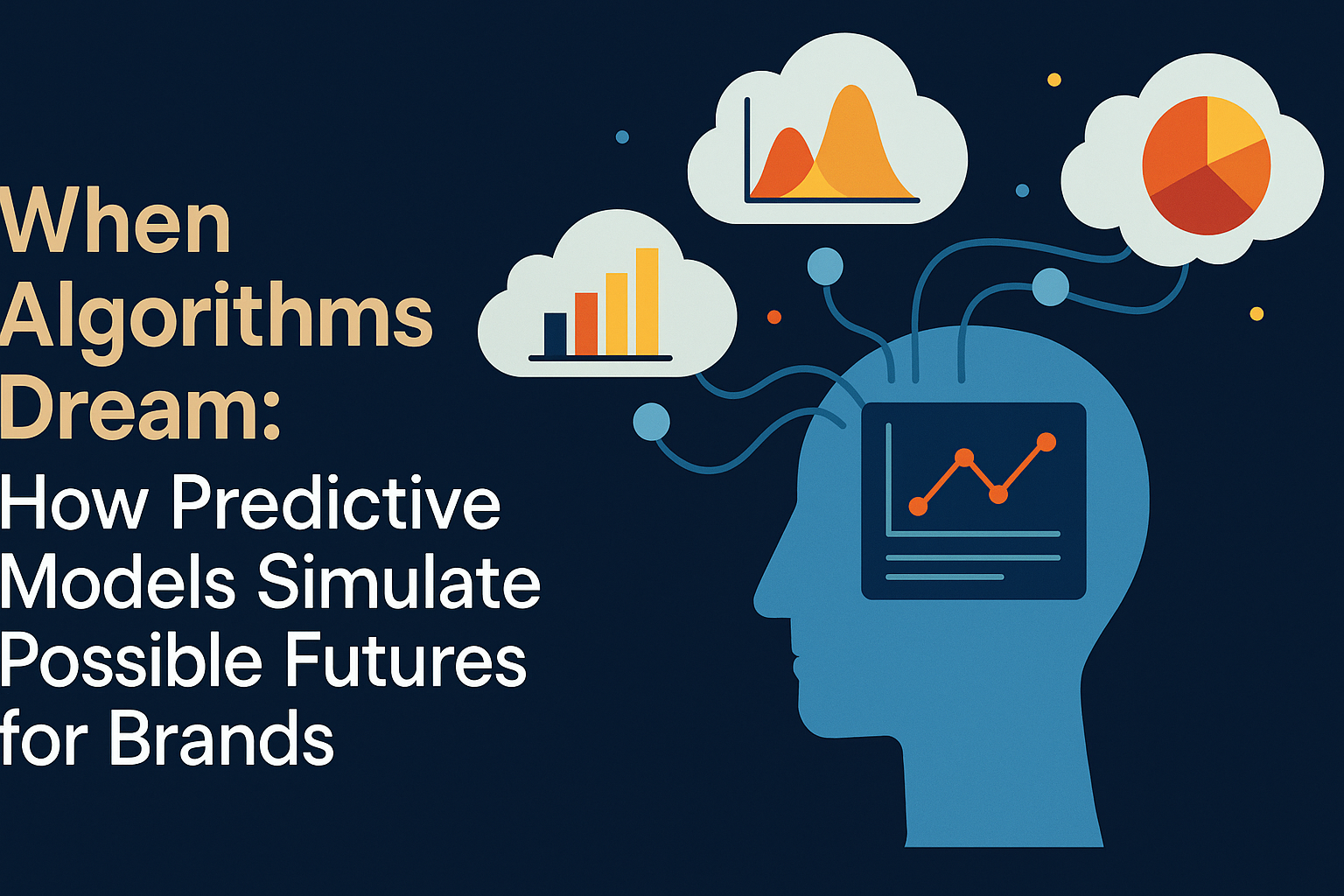
When Algorithms Dream: How Predictive Models Simulate Possible Futures for Brands
How predictive models imagine possible futures for smarter brand decisions.
Introduction: The Art of Seeing Tomorrow
If brands once navigated the marketplace with maps drawn from historical data, today they navigate with something closer to a crystal ball. Not a mystical orb, of course, but a network of algorithms—systems that learn, pattern-match, and simulate thousands of futures long before a single outcome unfolds in the real world.
Predictive models have evolved into something almost poetic: engines that “dream” about possibilities. They imagine demand curves bending upwards, customer sentiment shifting sideways, competitive ecosystems tilting in unexpected directions. These systems test futures the way writers test storylines—branching paths, alternate endings, subtle variations in tone or timing.
This fusion of creativity and computation sits at the heart of multi-scenario forecasting, one of the most powerful disciplines available to brands today. It allows organisations not merely to react or optimise—but to prepare, to shape decisions, and to choose among potential tomorrows with clarity.
In this long-form exploration, we will look at:
- why predictive models do not produce a single future but many
- how algorithms “dream” in structured and unstructured ways
- the mechanics and types of multi-scenario forecasting
- the risks, biases, and coordination challenges
- how creative thinking amplifies analytical output
- the future of forecasting as models become more autonomous and emotionally aware
This is not a technical manual. Instead, it is a guided journey—part conceptual, part practical, part imaginative—through the world of simulated futures.
Welcome to the place where data becomes a possibility.
1. The Myth of the Single Future
For decades, businesses treated forecasts as the definitive truth: an upward line on a graph surrounded by a confidence interval, perhaps, but still pointing towards a singular destiny. The problem with this assumption is simple: markets are not static, customers are not predictable in linear ways, and external forces rarely obey neat mathematical expectations.
Reality branches.
A change in the economy, a viral trend on social media, an unexpected competitor, a new regulation, or even a sudden cultural shift can make yesterday’s models obsolete. The world does not unfold along one path—it moves through an interlocking set of probabilities.
This is where multi-scenario forecasting reimagines the role of predictive models:
- instead of predicting one future, they simulate many
- instead of offering certainty, they provide clarity about uncertainty
- instead of assuming stability, they test volatility and fragility
Brands no longer ask:
“What will happen?”
Instead, they ask:
“What could happen—and what should we do if it does?”
This shift is profound. It moves forecasting from prediction to preparedness, from optimisation to resilience, from chance to choice.
2. How Algorithms Dream: The Foundations of Predictive Imagination
Algorithms do not dream in the way humans do, yet the metaphor is surprisingly accurate. When models generate simulations, they construct alternative realities based on patterns, probabilities, and assumptions. It is a form of computational dreaming: an exploration of universes that do not yet exist.
So what exactly are these models doing?
a. Pattern recognition as memory
Just as human dreams draw on fragments of memory, predictive models begin by ingesting historical data:
- purchase histories
- customer journeys
- product performance
- seasonal behaviours
- marketing responses
- macroeconomic signals
This structured “memory” allows algorithms to detect repeating sequences, subtle correlations, and causal relationships.
b. Probability as imagination
From memory springs imagination. Models use statistical distributions to ask:
- What if behaviour increases by 10%?
- What if demand collapses for six weeks?
- What if customers respond differently to price changes?
- What if churn accelerates among a specific segment?
They stretch the data, distort variables, combine shocks, introduce noise, and generate possible timelines—some likely, some extreme, some beautifully unexpected.
c. Simulation as storytelling
Every simulation is a story:
- a product launch that exceeds expectations
- a sudden drop in customer trust
- a shift in engagement patterns
- a changing response to marketing efforts
These stories help brands understand resilience, fragility, opportunity, and risk.
d. Feedback loops as evolution
Unlike static forecasts, modern predictive systems evolve. Their “dreams” become clearer as real-world data flows back into them, refining assumptions and adjusting probabilities.
The more they learn, the more imaginative they become.
3. The Mechanics of Multi-Scenario Forecasting
Multi-scenario forecasting blends statistical modelling, machine learning, and systems thinking. Its goal is not to find the “right” answer but to generate a map of possibilities. Here are the core frameworks that power it:
3.1. Deterministic vs Probabilistic Scenarios
Deterministic models assume fixed inputs:
“If X happens, then Y follows.”
Useful for short-term operational decisions.
Probabilistic models accept uncertainty:
“X might occur with 40% probability, Y with 25%, Z with 10%…”
This captures real-world complexity and provides richer strategic insight.
3.2. Branching Scenarios
Common in strategic planning, branching scenarios simulate:
- best case
- worst case
- baseline
- stressed variations
For example, a retailer might examine:
- best case: early seasonal demand surges
- worst case: supply chain disruption
- middle case: steady but slow demand growth
Branching reveals not only outcomes but “tipping points”.
3.3. Monte Carlo Simulations
These models generate thousands of futures by repeatedly randomising inputs, such as:
- demand
- pricing changes
- customer behaviour shifts
- competitive pressure
The output is a probability distribution rather than a single forecast.
This is the closest computational equivalent to dreaming.
3.4. Agent-Based Models
These simulate individuals (“agents”) interacting with each other and their environment. Agents might represent:
- customers
- competitors
- suppliers
- social networks
Useful for understanding phenomena such as:
- viral trends
- community influence
- market contagion
- brand advocacy growth
It is prediction as ecosystem modelling.
3.5. Reinforcement Learning for Scenario Exploration
Reinforcement learning (RL) algorithms continuously learn from outcomes:
- they test possible actions
- measure the resulting reward
- refine strategy
RL systems often discover counterintuitive futures—scenarios humans might never imagine.
4. Why Brands Need Multi-Scenario Forecasting
Predictive models once aimed for accuracy. Today, accuracy alone isn’t enough. Brands need:
- resilience: the ability to withstand shocks
- adaptability: the capacity to pivot quickly
- insight: awareness of patterns before they visibly emerge
- preparedness: contingency plans for volatility
Let’s look at the practical value.
5. What Scenario Simulation Reveals That Traditional Forecasting Cannot
5.1. Vulnerabilities Before They Break
A sudden 20% drop in customer sentiment is rarely random.
Simulations reveal weak points:
- segments likely to churn
- touchpoints where friction builds
- features customers overlook
- pricing thresholds customers resist
Brands can act before decline becomes visible.
5.2. Hidden Opportunities
Many growth opportunities lie beneath current trends.
Simulations expose:
- product combinations likely to increase basket size
- moments where customers are most influenceable
- emerging micro-segments
- upcoming behavioural shifts
Predictive imagination becomes a competitive advantage.
5.3. Resource Optimisation
Scenario modelling helps brands decide:
- where to allocate budget
- when to scale marketing
- how to adjust staffing
- which initiatives yield highest long-term value
It is a blueprint for smarter choices.
5.4. Strategic Scenario Testing
Brands often want to test decisions such as:
- entering a new market
- adjusting subscription pricing
- launching a loyalty programme
- reducing customer service wait times
Instead of guessing outcomes, simulations project multiple trajectories.
This protects organisations from high-cost mistakes.
6. Creativity Meets Data: Why Forecasting Requires More Than Maths
Forecasting is not purely analytical.
It is also philosophical, psychological, and imaginative.
6.1. Creativity in Assumptions
Models only dream as creatively as the assumptions they are given.
If a brand assumes:
- “customers behave rationally”
- “competitors will not change strategy”
- “market conditions stay stable”
…then it severely limits the futures being explored.
Good forecasters must think like storytellers:
- “What if a new cultural behaviour emerges?”
- “What if desire shifts from convenience to sustainability?”
- “What if loyalty becomes community-driven rather than reward-driven?”
Creativity broadens the horizon of possibility.
6.2. Narrative Scenarios
Humans understand futures through stories, not spreadsheets.
Narrative scenarios blend:
- data
- psychology
- economics
- culture
- behaviour
A narrative might explore:
- “In a future where attention spans collapse, micro-interactions dominate brand communication.”
- “In a scenario where customers trust algorithms more than companies, predictive assistants become decision-makers.”
These are not fantasies—they are frameworks for strategic planning.
6.3. The Role of Intuition
Despite algorithmic power, human intuition remains essential.
Leaders must interpret:
- what the simulated futures mean
- which ones align with vision
- how to translate insight into action
Humans choose which future to pursue.
Algorithms simply show what is possible.
7. Risks and Pitfalls: When Predictive Dreams Become Nightmares
Although multi-scenario forecasting offers brands a powerful lens into possible futures, it also carries a series of risks that can undermine decision-making if left unchecked. Predictive intelligence is only as strong as the assumptions, data, and governance shaping it. When organisations rely too heavily on simulations without understanding their limitations, the outcome can shift from strategic foresight to strategic misjudgement. Below are the key dangers brands must recognise—and actively manage—when integrating multi-scenario forecasting into their decision frameworks.
7.1 Overfitting the Past: When History Misleads the Future
One of the most fundamental risks is overfitting, which occurs when predictive models rely too heavily on historical data. This creates an illusion of stability—assuming that patterns observed in the past will continue indefinitely. Such assumptions are comforting but misleading. Markets today are shaped by social media-driven trends, geopolitical shifts, new consumer values, and technological disruptions that rarely mirror yesterday’s conditions.
Overfitted models risk becoming blind to emerging behaviours. A single cultural shift—like the rise of remote work, climate-conscious spending, or virality on digital platforms—can invalidate years of carefully collected data. When that happens, the forecast collapses. Brands that cling to these outdated projections may miss innovation windows, misallocate resources, or overcommit to strategies that no longer reflect reality. Robust forecasting requires an acceptance that the future may behave unlike anything previously observed.
7.2 Confirmation Bias: The Danger of Predicting What You Want to See
Another major risk is confirmation bias, where analysts unintentionally design scenarios that affirm their existing beliefs or strategic preferences. Instead of using forecasting to challenge assumptions, they use it to reinforce them. This distorts simulations in subtle but meaningful ways.
Healthy scenario modelling must be uncomfortable. It should explore worst-case outcomes, improbable shocks, rapid behavioural shifts, and “black swan” events—those rare but high-impact disruptions that redefine industries. When teams fail to examine extremes, they undermine the very purpose of multi-scenario analysis: preparing for a range of futures rather than the one they hope will occur.
To counter confirmation bias, organisations must create processes that reward dissent, encourage diverse perspectives, and deliberately test contrary scenarios. Forecasting is only valuable when it interrogates—not protects—strategic assumptions.
7.3 False Confidence in Probabilities: When Numbers Mislead Decision-Makers
Probabilities can provide a misleading sense of certainty. A scenario with a 70% chance of success may look comforting, but the remaining 30% represents meaningful risk—especially in high-stakes situations like pricing changes, market expansion, or product launches. Brands frequently overestimate the significance of the larger number and underestimate the implications of the smaller one.
Forecasting should be understood as a risk boundary, not a guarantee. Decision-makers must learn to interpret probability as a spectrum of outcomes rather than a single dependable prediction. A scenario with low probability may still demand preparation if the consequences are severe. Mature organisations weigh likelihood alongside impact, ensuring they are resilient even in less favourable outcomes.
7.4 Ethical Implications: When Forecasts Reinforce Inequality
Perhaps the most overlooked risk involves ethical implications. Scenario models can unintentionally embed or amplify biases present in data. If historical data reflects inequalities—whether in pricing, access, demographic targeting, or service quality—predictions built on that data risk repeating or intensifying these patterns.
Ethical concerns include:
- models that unfairly segment customers based on sensitive attributes
- exclusionary scenarios that deprioritise minority groups
- automated decisions that negatively impact vulnerable populations
Responsible forecasting requires strong governance, continuous auditing, and diverse oversight to ensure models serve fairness, transparency, and inclusion. Ethical foresight is now as important as statistical foresight.
8. Case Studies (Fictional but Plausible)
Telecommunications: Preventing Network Strain Before It Happens
A large telecom provider faced growing pressure from customers working remotely, streaming content, and relying heavily on digital infrastructure. Instead of planning network upgrades based solely on historical usage, the company deployed multi-scenario forecasting to simulate thousands of potential demand patterns.
One scenario model predicted an unexpected surge in evening data consumption—not driven by typical streaming behaviour, but by the rapid adoption of AI-powered home tools and remote collaboration platforms. Though this future was not the most probable, it revealed a critical vulnerability: neighbourhood-level bandwidth saturation.
Instead of waiting for real-world complaints, the telecom provider:
- proactively expanded network capacity in predicted hotspots
- prioritised infrastructure upgrades for high-risk zones
- tested automated load-balancing protocols
- launched targeted customer communication about peak usage
When the surge eventually materialised months later, the company experienced minimal service disruption. Competitors, meanwhile, struggled with outages and customer dissatisfaction. Forecasting allowed the brand to avoid reputational damage while strengthening long-term customer trust.
Consumer Goods: Forecasting the Rise of a Micro-Trend
A global consumer goods company wanted to understand early signals of emerging product trends. Traditional forecasting methods focused on long-term patterns, but lacked sensitivity to rapid cultural shifts. By adopting predictive modelling with social data inputs, the company simulated scenarios around niche beauty and lifestyle trends.
One simulation revealed a low-probability but high-growth scenario: a sudden rise in demand for “skin barrier protection” products driven by social media creators. This term was barely present in mainstream analytics, but scenario modelling showed its potential to explode due to convergence between dermatology influencers, seasonal changes, and rising consumer anxiety about over-exfoliation.
Acting on this insight, the company:
- accelerated R&D for gentle formulations
- partnered with dermatologists and creators early
- prepared targeted messaging emphasising repair and protection
- aligned distribution with projected high-adoption markets
Months later, the micro-trend became a global skincare movement. Competitors scrambled to respond, while the company was already positioned with products, messaging, and supply chain readiness. A “dreamed-up” scenario became a real-world advantage.
Education Technology: Anticipating Learning Drop-Off
An education technology platform noticed that user engagement varied widely between different types of learners. Instead of studying churn retrospectively, the company simulated multiple future learning pathways using engagement data, assessment patterns, and behavioural signals.
One scenario highlighted a previously unnoticed risk: students who performed moderately well—neither struggling nor excelling—were most likely to disengage. Their learning plateau triggered boredom, leading to reduced login frequency and eventual churn.
In response, the platform:
- introduced adaptive difficulty features
- created micro-challenges to re-engage plateaued learners
- developed predictive alerts for educators
- offered personalised motivational nudges
Within months, engagement increased significantly among this segment. The scenario not only prevented churn—it reshaped the company’s understanding of learner psychology.
Food & Beverage: The Menu Mix Forecast
A restaurant chain facing volatile consumer preferences turned to multi-scenario forecasting to optimize menus. Instead of relying solely on past sales, simulations combined social trends, ingredient availability, local tastes, economic pressure, and competitor pricing.
One scenario predicted a sharp increase in interest for plant-forward comfort dishes—not full vegan meals, but hybrid offerings blending familiarity with lighter, health-conscious ingredients.
The restaurant tested this scenario by:
- adjusting seasonal menus
- creating plant-forward versions of top-selling dishes
- training chefs on new preparation techniques
- preparing supply chains for flexible ingredient sourcing
The strategy paid off. As cost-of-living concerns grew and health awareness spiked, customer demand shifted exactly as the forecast had suggested. The chain captured significant new market share while maintaining operational stability.
9. The Future: Autonomous Forecasting Systems That Dream Without Prompting
Forecasting is undergoing a profound transformation. What once required teams of analysts, scheduled reports, and structured assumptions is evolving into a continuous, intelligent process—an ecosystem that thinks, learns, and adapts independently. As predictive systems become more autonomous, the boundary between foresight and decision-making begins to dissolve. The future of forecasting is not about better reports; it is about self-adjusting, self-learning environments that shape strategy in real time.
a. Continuous Scenario Simulation: Always-On Foresight
In the next wave of predictive evolution, models will no longer wait for human prompts. Instead, they will operate continuously—running tens of thousands of micro-simulations each day, monitoring fluctuating behavioural patterns, market signals, emotional trends, and environmental conditions.
These systems will detect shifts long before analysts can spot them:
- subtle increases in customer hesitation
- regional variations in product interest
- unexpected clustering of complaints
- cultural trends forming at the edges of social media
This continuous dreaming, fuelled by real-time data ingestion, will create a living map of possible futures. Businesses will no longer “check” forecasts—they will live inside them.
b. Forecasts That Tell Stories: The Rise of Narrative Intelligence
As predictive ecosystems become more advanced, they will begin to narrate their own insights. Instead of presenting charts or confidence intervals, they will explain futures in sentences that resemble human reasoning:
“If shipping delays continue at the current rate, customer frustration will peak in six weeks. Prepare additional support capacity.”
This narrative intelligence bridges the gap between complex data outputs and human understanding. Decision-makers will no longer interpret raw probabilities—they will receive contextual interpretations, ready-made insights, and strategic framing. Forecasting becomes not just mathematical, but conversational.
c. Emotion-Aware Scenario Branching
Future predictions will integrate a deeper layer of human nuance: emotion. Algorithms will analyse tone of voice in support calls, sentiment shifts on social media, micro-deviations in browsing patterns, and even emerging anxieties or motivations.
Emotion-aware forecasting allows companies to model futures based on how customers feel, not just how they behave. Scenarios will branch according to:
- rising frustration
- growing loyalty
- emerging concerns
- shifting cultural moods
This creates predictions that are more human, more sensitive, and significantly more accurate.
d. Interconnected Predictive Ecosystems: Industries That Think Together
Forecasting will break out of organisational silos and expand across industries. Imagine:
- mobility platforms predicting route delays based on weather
- finance apps adjusting spending insights according to economic volatility
- retail systems preparing inventory as supply chain pressure mounts
- hospitality platforms forecasting booking surges from travel trends
These systems will communicate, creating predictive networks rather than isolated models. One industry’s signal becomes another’s early warning. The economy evolves into a shared anticipatory environment.
e. From Forecasting to Orchestration: Shaping, Not Predicting
The final stage of evolution is the most transformative: forecasting will move beyond observation and into orchestration. Predictive systems will not simply warn brands of possible outcomes—they will intervene to shape better ones.
Autonomous ecosystems will:
- recommend product changes before demand shifts
- adjust pricing dynamically based on sentiment and behaviour
- optimise communications to reduce friction at critical moments
- identify risks before they escalate
- test interventions in simulated environments
Forecasting becomes an act of co-creation—a partnership between humans and algorithms that shapes the future rather than merely predicting it.
10. Conclusion: The Responsibility of Seeing Tomorrow
When algorithms dream, they do not fantasise. They simulate. They explore. They warn. They reveal what we may become.
Brands equipped with multi-scenario forecasting gain a powerful advantage, but also a responsibility:
- to interpret futures ethically
- to respect uncertainty
- to avoid deterministic arrogance
- to make decisions that consider long-term human impact
Predictive models do not tell us what will happen.
They tell us what could happen—and ask:
What future will you choose to build?
Because the future is not found. It is designed