What the UK’s Latest Tech Summit Reveals About the Future of AI and Semiconductors
UK tech leaders explore the future of AI, semiconductors and advanced computing.
The UK’s Semiconductor and AI Ecosystem Comes Together
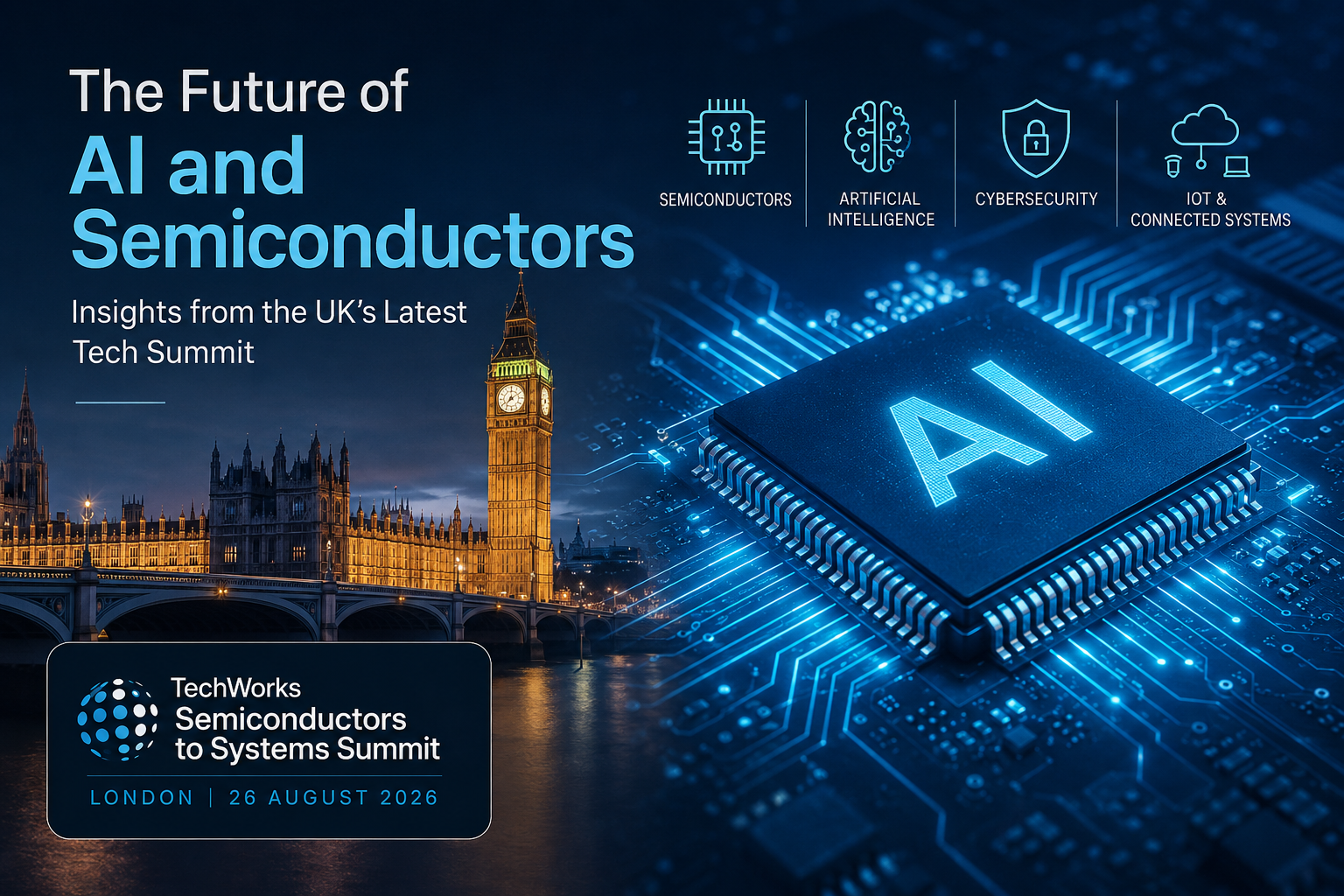
On 26 August 2026, London became a meeting point for some of the UK’s most important technology sectors as the TechWorks Semiconductors to Systems Summit 2026 brought together more than 600 technology leaders, over 300 companies and more than 70 exhibitors. Held at Novotel London West, the summit formed part of TechWorks’ 30th anniversary celebrations and was delivered in partnership with the UK Semiconductor Centre.
But the significance of the event went beyond its size.
The summit brought together areas of technology that are often discussed separately: semiconductor design, manufacturing, artificial intelligence, electronic systems, cybersecurity, computing, photonics, IoT and advanced engineering. For an industry increasingly dependent on collaboration between these fields, bringing them together under one roof offered a glimpse into where the UK's technology sector could be heading next.
The central message was clear: the future of AI will not be built through software alone. It will depend on the hardware, semiconductor technology, secure infrastructure and electronic systems underneath it.
From chips to complete systems
One of the most interesting aspects of the summit was its focus on the entire technology value chain.
Rather than treating semiconductors as an isolated industry, the event connected the journey from materials and chip design through manufacturing, packaging and integration to the final systems that businesses and consumers actually use.
This approach reflects an important change in the technology industry.
For years, the conversation around computing has largely centred on software. Smartphones, cloud computing, social media, applications and more recently generative AI have dominated the public discussion. Yet every one of these technologies ultimately depends on physical infrastructure.
AI models require powerful processors.
Processors require sophisticated semiconductor manufacturing.
Semiconductor manufacturing requires advanced materials, equipment and testing.
And the resulting chips must be integrated into reliable systems capable of operating securely and efficiently.
The summit's four main tracks — Build, Create, Scale and Secure — reflected this interconnected approach.
The Build track examined materials, manufacturing, semiconductor devices and advanced packaging. Create focused on systems, integration and verification. Scale addressed investment, commercialisation and the growth of semiconductor businesses, while Secure examined cyber resilience, trusted infrastructure and security.
Together, these areas demonstrate that the next generation of technology will require much more than simply developing a faster processor or a more sophisticated AI model.
Why semiconductors matter to AI
Artificial intelligence has created enormous demand for computing power.
Training and running advanced AI systems requires increasingly powerful processors, large amounts of memory and sophisticated networking infrastructure. As AI becomes embedded into more industries, the demand for specialised hardware is likely to increase further.
This is where semiconductor innovation becomes critical.
Traditional approaches to improving computing performance are becoming increasingly difficult and expensive. As transistor scaling becomes more challenging, the industry is exploring alternatives including advanced packaging, chiplets, heterogeneous integration and new semiconductor materials.
These technologies could allow manufacturers and system designers to combine different components more efficiently rather than relying entirely on making individual chips smaller.
The Build track at S2S26 specifically addressed this transition, with sessions covering materials innovation, semiconductor manufacturing, AI-driven process optimisation, advanced packaging and chiplet platforms.
This is significant for AI because future computing systems may increasingly be designed around the workload they are expected to perform.
Instead of one general-purpose processor doing everything, systems could combine specialised components for AI acceleration, memory, networking, security and other functions.
That could make future systems more powerful while also improving efficiency.
AI is moving closer to the physical world
Another major theme emerging from the summit was the relationship between AI and physical systems.
AI is no longer limited to applications running on computers or smartphones. It is increasingly being incorporated into vehicles, industrial machinery, robots, energy systems, healthcare technologies and other connected devices.
This creates a new challenge.
When AI becomes part of a physical system, simply producing an accurate result is not enough. The system also needs to be reliable, secure and capable of responding safely.
This is why the Create track's emphasis on systems integration, verification and functional safety is particularly relevant. The agenda included discussions around complex cyber-physical systems and functional safety across sectors such as automotive, aerospace, defence, energy and industrial automation. (TechWorks)
The future of AI therefore looks increasingly interconnected with engineering.
A self-driving vehicle, for example, cannot rely on an AI model alone. It needs sensors, processors, communications systems, software, cybersecurity measures, power electronics and safety mechanisms working together.
The same principle applies to smart factories, medical devices and autonomous robots.
The UK's opportunity
For the UK, this convergence could represent an important economic opportunity.
The country does not necessarily need to compete with every major global semiconductor manufacturer on the scale of the world's largest fabrication facilities. Instead, it can build on areas where it already has significant expertise, including semiconductor design, research, advanced materials, photonics, power electronics, system engineering and specialist technologies.
The summit's international and cross-sector nature highlighted the importance of this approach.
It brought together industry, academia, government, investors and international partners, creating opportunities for collaboration across the technology value chain. TechWorks describes S2S26 as a cross-value-chain summit covering everything from materials research and device design to secure systems, investment and global markets.
This matters because semiconductor development is rarely the work of a single company.
It requires universities conducting research, engineers developing technologies, manufacturers producing components, investors providing capital and governments establishing supportive policies and infrastructure.
The UK therefore has an opportunity to strengthen its position by becoming particularly good at connecting these different parts of the ecosystem.
And that may ultimately be one of the most important messages from the summit: the future of technology will belong not only to those who invent individual technologies, but also to those capable of connecting them.
What the Summit Says About the Future of AI, Computing and Cybersecurity
If Part 1 of the summit's message was about connectivity across the technology value chain, Part 2 was about what that connected ecosystem needs to deliver.
The next generation of AI and computing will have to become more powerful, more efficient and more secure.
That combination is becoming increasingly important as AI moves from experimental applications into everyday business operations and critical infrastructure.
The challenge of computing efficiency
AI's rapid expansion has created a major demand for computing resources.
Large AI models require enormous amounts of processing power, memory and data movement. As businesses deploy AI at scale, the cost and energy requirements associated with computing become increasingly important.
This means that simply adding more computing capacity is unlikely to be a complete solution.
The industry needs better architectures.
Advanced semiconductor packaging, chiplets, specialised processors and improved manufacturing processes are among the technologies being explored to achieve this.
The summit's Build programme examined precisely these issues, including advanced packaging, heterogeneous integration and system optimisation. It also explored how AI can be used within semiconductor manufacturing itself, including automated metrology, defect detection and intelligent manufacturing. (TechWorks)
This creates an interesting feedback loop.
AI needs better semiconductor technology.
But semiconductor manufacturers can also use AI to improve the way those semiconductors are designed and produced.
AI could help build the chips that power AI
This is one of the most important developments to watch.
AI is increasingly being used throughout engineering workflows. It can help identify patterns in manufacturing data, optimise processes, detect defects and support design decisions.
At S2S26, sessions included topics such as automated semiconductor metrology and the use of AI to identify manufacturing defects. (TechWorks)
The implications could be significant.
Semiconductor manufacturing is extraordinarily complex. Even small imperfections can affect the performance or reliability of a device. If AI can analyse large quantities of manufacturing data and identify patterns that humans might miss, manufacturers could potentially improve yield, efficiency and quality.
This is an example of AI becoming more than a consumer-facing technology.
It is becoming an industrial tool.
The rise of edge AI
Another major direction for AI is the movement of intelligence away from centralised cloud infrastructure and towards devices themselves.
This is commonly known as edge AI.
Instead of sending every piece of information to a remote data centre, an edge device can process data locally.
This can be particularly valuable when speed, privacy, reliability or connectivity matters.
Consider a manufacturing robot. If it needs to make an immediate decision based on a camera feed, sending that information to a distant cloud server could introduce unnecessary latency.
A local AI processor could make the decision directly.
The same concept could apply to vehicles, medical equipment, security systems and industrial machinery.
The summit's focus on intelligent edge systems and secure edge AI demonstrates why this area is becoming increasingly important. (TechWorks)
However, bringing AI closer to physical devices also creates new cybersecurity challenges.
AI and cybersecurity are becoming inseparable
The more intelligent and connected devices become, the more attractive they can become as targets.
A compromised smartphone is problematic.
A compromised industrial control system, autonomous vehicle or critical infrastructure device could be considerably more serious.
This is why cybersecurity must increasingly be considered during hardware and system design rather than added at the end.
The Secure track at S2S26 explored secure foundations and trusted infrastructure, including hardware-enforced cyber resilience, secure edge AI and silicon assurance.
This represents a shift in thinking.
Security is no longer purely a software issue.
The physical chip itself can contribute to security.
Hardware-based security features can help protect sensitive information, establish trust and reduce certain attack surfaces. This becomes particularly important as more devices become connected to networks and increasingly depend on AI.
Trust will become a competitive advantage
As technology becomes more integrated into critical environments, businesses will need to demonstrate that their systems can be trusted.
This involves more than preventing cyberattacks.
Organisations will increasingly need confidence that hardware has not been compromised, software behaves as intended and data is handled securely.
Supply chains are an important part of this equation.
Modern technology products often depend on components sourced from multiple countries and suppliers. Understanding where components come from and ensuring their integrity can therefore become increasingly important.
The summit included discussion of silicon assurance and tamper-evident supply chains, showing that trust is being considered at the chip level as well as at the software level.
For businesses, this could eventually influence purchasing decisions.
The fastest technology will not necessarily be the most attractive option if customers cannot trust it.
The importance of quantum-safe thinking
Cybersecurity is also being influenced by developments in quantum computing.
While large-scale practical quantum computers remain a developing technology, organisations are already considering how future computing capabilities could affect existing security systems.
This is particularly relevant for information that needs to remain confidential for many years.
The summit's Secure track included discussions around quantum safety alongside cyber resilience and trusted computing, demonstrating that security planning increasingly needs to consider both today's threats and tomorrow's technologies. (eventbrite.co.uk)
For UK businesses, this creates another reason to think about technology infrastructure strategically.
Cybersecurity can no longer be viewed simply as an IT department responsibility.
It affects hardware selection, software architecture, supply chains, data management and long-term business planning.
From data centres to devices
The future of AI will therefore probably involve a combination of technologies.
Large cloud-based systems will continue to handle complex workloads requiring substantial computing resources.
At the same time, smaller AI models and specialised processors will increasingly operate at the edge.
The result could be a distributed AI ecosystem in which intelligence exists across data centres, vehicles, factories, smartphones, sensors and other connected devices.
This creates enormous opportunities.
But it also creates enormous complexity.
Every additional connected device represents another potential security risk, another hardware requirement and another point where systems must communicate correctly.
That is why the semiconductor-to-systems approach highlighted at S2S26 is so important.
The future is not simply about creating better AI models.
It is about creating the infrastructure that allows those models to operate reliably in the real world.
What This Means for UK Businesses and the Future of Technology
Perhaps the most important question following the TechWorks Semiconductors to Systems Summit is not simply what was discussed in London.
It is what happens next.
Technology conferences can generate plenty of ideas, but their real value comes from turning those ideas into investment, products, partnerships and infrastructure.
The S2S26 agenda placed considerable emphasis on exactly this challenge through its Scale track, which focused on entrepreneurship, funding, international partnerships and the UK's future position within the global semiconductor value chain. (TechWorks)
Turning research into commercial technology
The UK has a strong research base.
Universities and research organisations across the country contribute to semiconductor engineering, photonics, materials science, computing and AI.
But developing excellent research is only one part of the process.
The technology also needs to reach the market.
This is where investment and commercialisation become essential.
The Scale programme included discussions around funding the future, connecting investors with semiconductor businesses and creating international partnerships. (TechWorks)
This reflects a broader challenge facing deep-tech companies.
Building a software startup can sometimes require relatively modest initial infrastructure.
Building a semiconductor company is different.
Hardware development, testing, manufacturing, certification and specialised engineering can require significant capital and long development cycles.
Companies therefore need access to patient investment and strong commercial networks.
International collaboration will matter
The semiconductor industry is global by nature.
No single country controls every stage of the supply chain.
Materials may come from one country, manufacturing equipment from another, chip design may take place elsewhere and final products may be assembled and sold globally.
For the UK, international partnerships will therefore be critical.
The summit included discussions involving representatives from Canada, Japan and European semiconductor ecosystems, focusing on how international collaboration can strengthen innovation, supply chains and market access.
This could become increasingly important as countries attempt to strengthen their semiconductor resilience.
Recent years have demonstrated how vulnerable global technology supply chains can become when geopolitical tensions, trade restrictions, natural disasters or manufacturing disruptions occur.
For businesses, resilience may increasingly mean having access to alternative suppliers, partners and manufacturing capabilities.
What businesses should take from the summit
Although the summit was focused heavily on deep technology, its lessons extend beyond semiconductor companies.
Businesses in almost every sector are becoming technology businesses in some form.
Retailers use AI for customer analysis.
Manufacturers use automation and computer vision.
Transport companies use connected systems.
Healthcare organisations rely on increasingly sophisticated digital infrastructure.
Financial institutions depend on secure computing systems.
Even small businesses increasingly depend on cloud platforms, digital payments and connected devices.
This means that developments in semiconductors and AI eventually influence a much wider business ecosystem.
For business leaders, several lessons stand out.
First, technology infrastructure matters.
AI applications are only as reliable as the systems supporting them. Businesses investing in AI should therefore consider computing capacity, networking, cybersecurity, data infrastructure and hardware requirements alongside software.
Second, security needs to be designed in from the beginning.
As AI becomes integrated into critical operations, cybersecurity cannot simply be an afterthought.
Third, efficiency will become increasingly important.
Businesses will need to consider not only what AI can do but also how much computing power, energy and infrastructure it requires.
Fourth, partnerships will matter.
The complexity of modern technology means that organisations will rarely be able to develop everything internally. Working with specialist technology companies, universities, suppliers and infrastructure providers can accelerate innovation.
The role of technology infrastructure
This is particularly relevant for companies such as Matriks, where reliable technology infrastructure forms the foundation for business operations.
The technology industry is moving towards an environment in which infrastructure must support increasingly demanding workloads while remaining secure, scalable and reliable.
For businesses, this means thinking beyond individual devices or applications.
A company's technology environment could involve cloud services, local computing, AI tools, cybersecurity systems, connected devices and internal networks. Each component needs to work effectively with the others.
The semiconductor-to-systems model provides a useful way of understanding this.
At the lowest level are the physical components.
Above them are processors, memory and electronic systems.
Then come operating systems, software and AI applications.
Finally, businesses and consumers interact with the resulting products and services.
A weakness at any level can affect the entire system.
The UK could play a specialised role
The summit also raises an important question about Britain's position in the global technology race.
The UK is unlikely to become the world's largest semiconductor manufacturing centre overnight.
However, it does not necessarily need to.
Its opportunity may lie in building strength across strategically important specialist areas.
These could include advanced semiconductor design, compound semiconductors, photonics, power electronics, AI hardware, cybersecurity, system engineering and research.
The UK's universities and technology companies can contribute expertise, while government initiatives and industry organisations can help connect those capabilities with investment and international markets.
The summit itself was an example of this approach.
By bringing together more than 600 leaders, 300 companies and 70 exhibitors across multiple technology communities, it demonstrated the potential value of connecting different parts of the ecosystem. (TechWorks)
AI's future will be physical
Perhaps the biggest conclusion from the event is that the future of AI will not exist exclusively on screens.
AI is moving into the physical world.
It will help factories identify defects.
It will support vehicles and transportation systems.
It will assist robots.
It will operate on edge devices.
It will become part of energy infrastructure.
It will influence healthcare technology.
And it will increasingly interact with the physical environment around us.
That means the technology industry needs to think differently.
The AI revolution is also a semiconductor revolution.
It is an electronics revolution.
It is a cybersecurity revolution.
And it is an infrastructure revolution.
What comes next?
The TechWorks Semiconductors to Systems Summit may ultimately be remembered less for any individual presentation and more for the ecosystem it brought together.
Its four-track structure — Build, Create, Scale and Secure — provides a useful framework for understanding where technology is heading.
Build the hardware and semiconductor technologies required for future computing.
Create the intelligent systems that turn those technologies into useful products.
Scale companies, investment and innovation so those products can reach global markets.
Secure the hardware, software and infrastructure on which everything depends.
These four priorities are closely connected.
A breakthrough semiconductor technology cannot have a meaningful impact without systems capable of using it.
An advanced AI system cannot reach its full potential without suitable computing infrastructure.
A successful technology business cannot scale without investment and skilled people.
And none of these developments can become sustainable if security and resilience are ignored.
The bigger picture
The summit offered a timely snapshot of the UK's technology ambitions at a moment when AI is changing the global computing landscape.
The industry is entering a period in which software and hardware are becoming increasingly inseparable.
AI needs semiconductors.
Semiconductors need advanced manufacturing.
Advanced systems need secure infrastructure.
And businesses need all of these technologies to work together.
For the UK, the opportunity is to strengthen the connections between these areas and turn its existing expertise into commercially successful technologies.
For businesses, the message is equally relevant: technology infrastructure is no longer simply a background function. It is becoming a strategic part of competitiveness.
And for the wider technology industry, the direction is becoming increasingly clear.
The next stage of the AI revolution will not be built by software alone. It will be built from the chip upwards.
The TechWorks Semiconductors to Systems Summit brought that reality into focus in London on 26 August 2026 — connecting the people, companies and technologies that will help determine what the UK's digital future looks like.
If the conversations at S2S26 translate into investment, collaboration and commercial innovation, the summit could prove to have been more than a celebration of 30 years of TechWorks. It could mark another step towards a stronger, more connected and more resilient UK deep-tech ecosystem.